On this page
- Choose by the routine you want to repeat
- What “pour-over” and “drip” mean here
- When automatic drip is the easier place to start
- When pour-over is the better first experiment
- Go deeper: control is a workflow choice, not a quality score
- Your next step
- Frequently asked questions
- Sources and scope
- Related guides
MELB NOTE · COFFEE · HOME BREWING
A filter coffee choice is often less about finding the “best” cup and more about deciding how much of the brewing routine you want to hold in your own hands.
By MELB NOTE Editorial · Reviewed 5 September 2026 · No sponsorship or affiliate links
The short answer
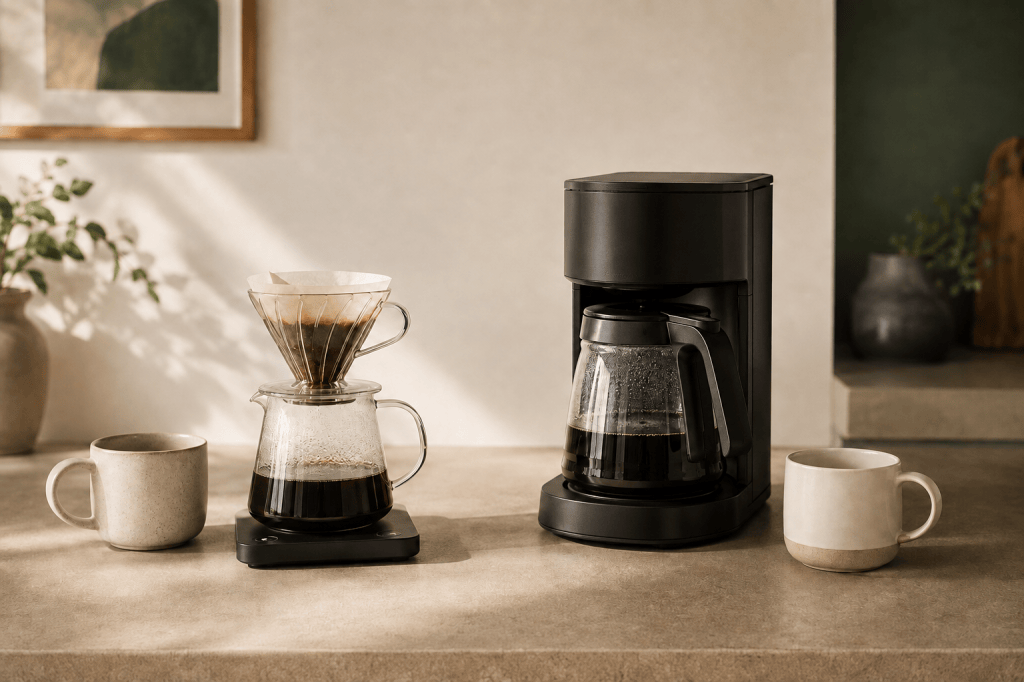
Pour-over and automatic drip coffee both send water through coffee in a filter. The difference is who delivers the water: with pour-over, you pour it by hand; with automatic drip, the machine does that part for you.
Choose automatic drip coffee when you want a lower-touch routine or often need more than one cup. Choose pour-over when you want to take part in the pour and adjust the workflow as you learn. The National Coffee Association describes the same broad distinction, while noting that capacity depends on the brewer and that manual pouring asks for more technique. Neither method is a universal quality winner.
Both are filter coffee. In this guide, “drip” means an automatic drip coffee maker, not every coffee brewed through a filter.
The practical trade-off is involvement. Pour-over keeps the water delivery in your hands; automatic drip hands it to the machine.
Choose the routine first. Start with automatic drip for a simpler, often larger-batch setup. Start with pour-over if the hands-on part is what you want to explore.
Choose by the routine you want to repeat
| Question | Pour-over coffee | Automatic drip coffee |
|---|---|---|
| Who delivers the water? | You pour water over the coffee by hand. | The machine delivers water over the coffee. |
| How hands-on is it? | You stay involved during the brew. | The machine handles the water-delivery stage. |
| What does it usually suit? | A smaller, more deliberate brewing moment; capacity depends on the brewer. | A lower-touch household routine; many machines can make a larger batch. |
| What is the learning demand? | You need to become comfortable with a manual pouring process. | You still set up coffee and a filter, but the machine takes over the central brewing action. |
| What can make a routine repeatable? | Keeping your own setup and pour routine consistent. | Repeating the machine-led setup with the same coffee, water, filter and care routine. |
The table is a choice guide, not a taste ranking. Coffee, water, filter type, grinder, machine design and maintenance can all change the result. A routine can be easier to repeat without every cup being guaranteed identical.
What “pour-over” and “drip” mean here
Pour-over is a manual filter method: you hand-pour water over coffee grounds held in a filter. The coffee then passes into a mug, carafe or another container. That simple sequence is why pour-over lets you take a more active role in the brewing process.
Automatic drip coffee also uses a filter, but an automatic machine slowly delivers hot water over the grounds and collects the brewed coffee in a pot or carafe. The key word is automatic. It keeps this article from treating a hand-poured filter coffee and a machine-led filter coffee as the same decision.
When automatic drip is the easier place to start
Automatic drip is usually the more straightforward starting point if coffee needs to fit around a busy morning. Once coffee and a suitable filter are in place, the machine handles water delivery. Many automatic drip makers also make a larger batch, which is useful when one brew needs to serve more than one cup.
That is a workflow advantage, not a promise about flavour. A machine does not remove every variable: coffee, water, filter choice, settings and cleaning still matter. If your aim is to build a calm, repeatable routine before learning more hands-on techniques, automatic drip is a sensible first branch.
When pour-over is the better first experiment
Pour-over is a good first experiment when the act of brewing is part of the appeal. You add the water yourself, so the method naturally asks you to pay attention to the brewer and the pour. The National Coffee Association describes it as a precise manual process that involves learning techniques.
That does not mean you need to chase a perfect pattern. It means pour-over can suit someone who wants a smaller, more deliberate brewing window and is happy for the process to be part of the morning rather than something that happens in the background.
Editor’s note: Pick the method you are most likely to use on an ordinary weekday. A simple routine you understand is a more useful starting point than a more involved setup you never reach for.
Go deeper: control is a workflow choice, not a quality score
“More control” can sound as though pour-over must produce better coffee. It does not. It only tells you that water delivery is in your hands. That creates more moments to observe and adjust your own routine; it also asks for more attention while brewing.
With automatic drip, the machine takes over that stage. Its value is not that it makes every cup the same, but that it can make the central action easier to repeat when you use the same setup. Coffee brewing still has variables, so it is useful to keep one change at a time when you are learning.
If you later want to work on the amount of coffee and water, use our coffee-to-water ratio guide. For method-specific grinding context, see coffee grind size for beginners. Those pages go deeper on their own questions; this guide is only about choosing a manual or automatic filter workflow.
Your next step
- Name your ordinary use case. Is coffee usually one quiet cup, or does it need to cover several cups while you do something else?
- Choose the involvement level. If you want to pour and observe, start with pour-over. If you want the machine to handle water delivery, start with automatic drip.
- Change one thing at a time. Once the method is chosen, use the same basic routine a few times before changing coffee, water amount or grind. If you are still deciding what to buy, our home coffee equipment guide can help you keep the setup proportionate to your routine.
Frequently asked questions
Is pour-over coffee the same as drip coffee?
Both are filter-brewing methods, but this guide uses “drip coffee” to mean automatic drip coffee. Pour-over is hand-poured; automatic drip uses a machine to deliver the water.
Does pour-over always taste better?
No. The methods differ in workflow and control, not in a universal quality score. The coffee, water, filter, equipment and the way a particular setup is used can all matter.
Can a pour-over make more than one cup?
It can, depending on the brewer and vessel. Capacity is not fixed by the name “pour-over”, so check the specific brewer rather than assuming that all manual setups are single-cup only.
Is automatic drip coffee only for large batches?
No. Many automatic drip makers can make larger batches, but machine capacities differ. The useful question is whether the machine’s capacity and routine match how much coffee you usually make.
Should I change my coffee ratio or grind when I switch methods?
Possibly, but this is not a one-size-fits-all recipe. Start with the instructions for your brewer and use the linked ratio and grind-size guides to make one considered adjustment at a time.
Sources and scope
These sources support the manual-versus-automatic filter-brewing distinction, the convenience and typical batch context of automatic drip machines, and the learning/control context of pour-over. They do not establish one universal recipe, serving size, taste winner or guaranteed level of consistency. Reviewed 5 September 2026.


 MELB NOTE