Melbourne Notes
By MELB_NOTE
The short answer
Yes, but only on the right night. The Bureau of Meteorology lists the coastline of Victoria as the northern limit of aurora visibility at Kp 5, a minor geomagnetic storm. Below that, the best chance is in Tasmania. To catch a good night, subscribe to the Bureau’s “Possibility of Auroral Event” emails, check the cloud cover forecast, and head to a dark spot with a clear view south, ideally some time between 10pm and 2am.
Searches for “aurora Melbourne” jumped this week, so this guide puts the essentials in one place: what the Kp number means, which notices the Bureau issues and how much warning each one gives, and where people in Melbourne tend to go to look. It is written from the Bureau of Meteorology’s own aurora pages, read on 11 October 2026.
30-second summary
- Kp measures geomagnetic activity over 3 hours. A higher Kp means a better chance at lower latitudes.
- Kp 5 (minor storm) is the level the Bureau lists for the coastline of Victoria.
- An Outlook gives 3 to 7 days of notice, a Watch up to 48 hours, and an Alert means activity is in progress.
- Look south, get away from city lights and check cloud cover before you drive anywhere.
- A phone camera often shows colour that the eye does not.
Melbourne needs at least a minor geomagnetic storm (Kp 5) to see the aurora

The K index describes geomagnetic activity over a 3-hour period. The larger the number, the better the chance of seeing an aurora at lower latitudes, which in Australia means further from Tasmania. The Bureau publishes two versions. K aus is an estimate for the Australian region from the Australian Space Weather Forecasting Centre, updated about every 5 minutes. Kp is the planetary index from NOAA’s Space Weather Prediction Center, issued every 3 hours.
The Bureau’s Northern Limit of Aurora Visibility table turns those numbers into places. At Kp 3 (unsettled) the limit is southern Tasmania. At Kp 4 (active) it is all of Tasmania. At Kp 5, a minor storm, it reaches the coastline of Victoria. At Kp 6 (major storm) it is the southwest coast of Western Australia, at Kp 7 (severe) southern New South Wales, at Kp 8 (severe) southern Queensland, and at Kp 9 the tropics.
In practice, that means a quiet night will not do. Melbourne sits on Port Phillip Bay, and the Victorian coast only enters the picture once activity reaches minor storm level. City lights also wash out faint displays, which is why the next sections focus on warning time and location.
Watches, alerts and outlooks tell you how much warning you have

The Australian Space Weather Forecasting Centre issues three kinds of aurora notice on the Bureau’s aurora page. They differ mainly in how far ahead they speak.
Aurora Outlook. Lead time of 3 to 7 days. It is issued for large active solar regions or significant coronal holes, and it is infrequent.
Aurora Watch. Lead time of up to 48 hours. It is issued only when a significant coronal mass ejection (CME) or coronal hole is likely to be geo-effective, meaning likely to disturb the Earth’s magnetic field.
Aurora Alert. Issued when activity favourable for viewing is in progress. This is the “go now” notice. Times on the notices are in UT (universal time), so convert to Melbourne time before you plan your night. Melbourne is ahead of UT, and the gap changes when daylight saving starts or ends.
How to get the notices
The Bureau offers an email mailing list. Go to Products and Services, then Mailing List, and choose “Possibility of Auroral Event”. The Bureau’s Space Weather API also provides the current K index and aurora notices, which is useful if you want to build your own alert.
The aurora page also links to a cloud cover forecast and an auroral oval prediction tool. Check cloud cover as well as Kp, because a strong display is invisible behind a solid layer of cloud.
Head south to a dark coast with a clear southern horizon

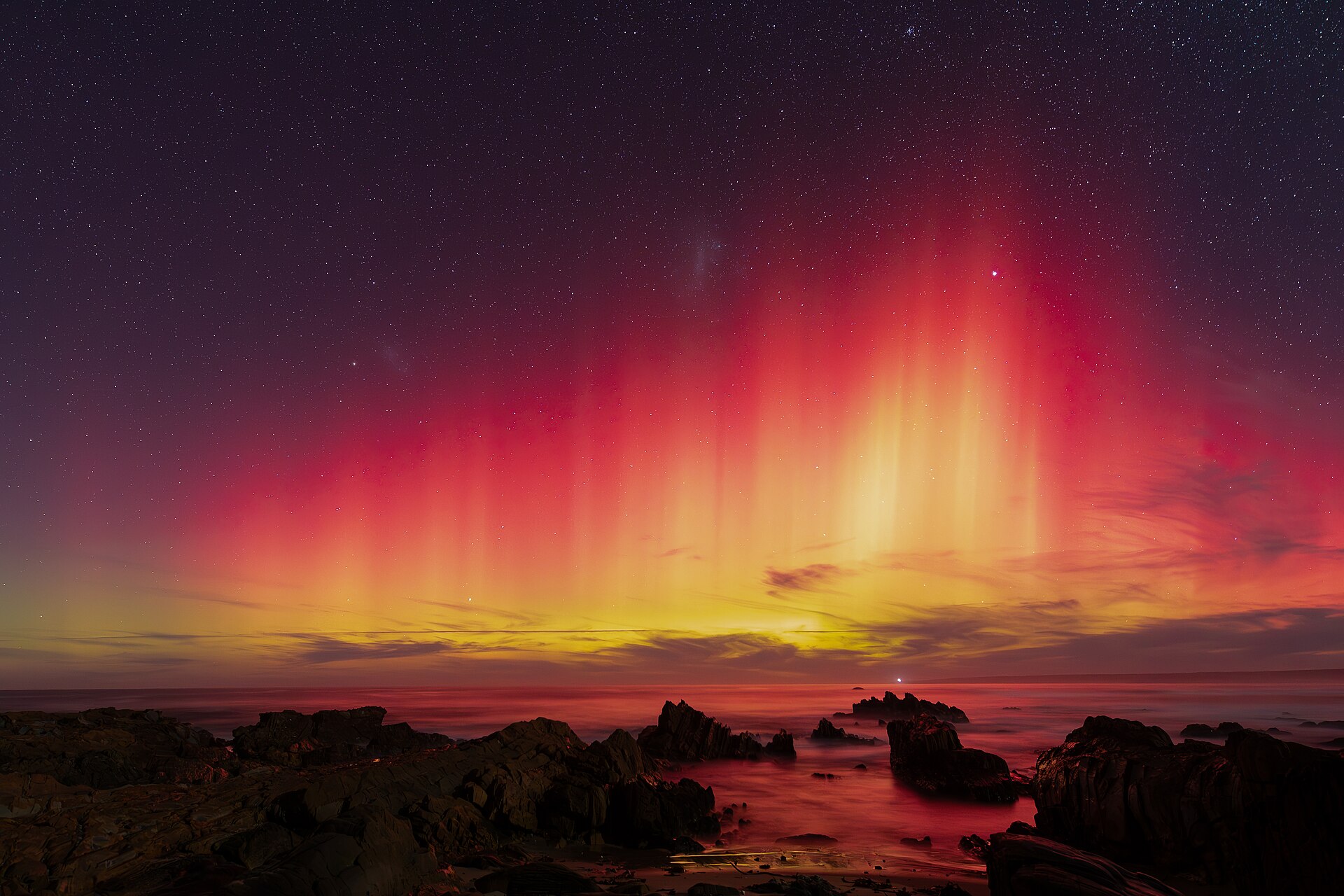
The photo above, taken on the Victorian coast, shows how subtle a low-latitude aurora can be: a faint glow along the horizon under a sky full of stars. That is why location matters as much as the Kp number.
Beat, in its guide to seeing an aurora australis from Melbourne, suggests darker spots with a clear southern horizon, such as the Bellarine Peninsula, the Mornington Peninsula, the You Yangs and Phillip Island. It also says peak viewing during storms is commonly between 10pm and 2am.
A few general habits help wherever you go:
- Face south, and pick a place where nothing blocks the view to the southern horizon.
- Get well away from city and street lights.
- Give your eyes time to adapt to the dark, and avoid looking at a bright phone screen.
- Take a photo. A phone camera, especially in night mode, often shows colour that the eye does not.
What this week’s activity means (9 to 11 October 2026)
This week’s searches followed news coverage of a space weather warning. According to Marie Claire Australia, a Bureau of Meteorology geomagnetic disturbance warning (G1 to G2) is active from 9 to 11 October 2026, with the strongest displays expected in Tasmania and Victoria.
Use the ladder earlier in this guide to read that in context. Tasmania is the most favoured location at lower Kp levels, and Victoria needs Kp 5 or more, so a warning that favours Tasmania and Victoria is a reason to check the Bureau’s live Kp and cloud cover rather than a promise of a display. If you are reading this after 11 October, the same checks apply to the next event.
For the current situation, the Bureau’s aurora page is the place to look, and the mailing list will tell you when an Alert is issued.
Questions people ask
Can you see the aurora australis from Melbourne?
Sometimes. The Bureau of Meteorology lists the coastline of Victoria as the northern limit of visibility at Kp 5, a minor storm. Most nights are quieter than that, so it takes a geomagnetic storm and clear skies.
What Kp level do I need to see the aurora in Melbourne?
Kp 5 is the level at which the Bureau’s table reaches the coastline of Victoria. Kp 3 and Kp 4 favour Tasmania, and higher levels push the limit further north.
What is the difference between an aurora watch and an aurora alert?
A Watch gives up to 48 hours of notice and is issued when a significant CME or coronal hole is likely to be geo-effective. An Alert is issued when activity favourable for viewing is in progress, so it is the notice to act on straight away.
What time of night is best?
Beat says peak viewing during storms is commonly between 10pm and 2am. Check the Bureau’s notices, which use UT, and convert to Melbourne time.
How do I get aurora alerts for Melbourne?
Subscribe to the Bureau of Meteorology mailing list under Products and Services, Mailing List, “Possibility of Auroral Event”. The Bureau’s Space Weather API also provides the current K index and aurora notices.
Sources and scope
- Bureau of Meteorology, Australian Space Weather Forecasting Centre: Aurora
- Bureau of Meteorology: Northern Limit of Aurora Visibility table
- Marie Claire Australia: aurora australis alert, October 2026
- Beat: Can you ever actually see an aurora australis from Melbourne?
Photo credits:
- Cover: Caroline Jones, aurora australis at Mallacoota, Victoria, 1 June 2025, CC BY 2.0, via Wikimedia Commons.
- Body: Caroline Jones, Mallacoota, Victoria, 28 August 2022, CC0, via Wikimedia Commons.
- Diagrams: drawn by MELB NOTE from the Bureau of Meteorology pages above.
Scope: This is general viewing guidance, not a forecast. Kp thresholds are the Bureau’s northern-limit figures, and actual visibility depends on conditions, cloud and your location. Notice times are in UT. Sources checked 11 October 2026.


.jpg)
.jpg)