Melbourne Notes
By MELB_NOTE
The short answer
The first Melbourne Cup was run on Thursday 7 November 1861, with 17 starters and a crowd of about 4,000. Archer won. The race was originally two miles and has been 3,200 metres since 1972. The 2026 race is on Tuesday 3 November, and the VRC calls it the 165th.
This is a history of the race, not a guide to the day. It draws on Wikipedia’s Melbourne Cup article and the Victoria Racing Club (VRC) Lexus Melbourne Cup Day page, both read on 2 November 2026 (Melbourne time). We used no other source. Wikipedia is community-edited and is inconsistent in a few places, so where it contradicts itself we say so or leave the figure out.
30-second summary
- First run: Thursday 7 November 1861. First winner: Archer.
- Distance: two miles at first, 3,200 metres since 1972.
- Records: Archer was the first two-time winner; Makybe Diva is the only three-time winner.
- Field limit: 24 starters, for safety reasons.
- 2026: Group 1 Lexus Melbourne Cup, Tuesday 3 November, a public holiday across Victoria.
The first Melbourne Cup was run on 7 November 1861 and the 2026 race is the 165th
According to Wikipedia, the first Melbourne Cup was run on Thursday 7 November 1861 with 17 starters and a crowd of about 4,000. The winner was Archer, ridden by John Cutts and trained by Etienne de Mestre. The prize was 710 gold sovereigns and a gold watch, and the winner took all.
The VRC page for the 2026 race describes it as the Group 1 Lexus Melbourne Cup over 3200 m on Tuesday 3 November 2026. It calls it the “165th of Series” and says the race was first run on Thursday 7 November 1861. Our own subtraction: 2026 minus 1861 is 165 years later. We do not claim the race was run every year in between; “165th” is the VRC’s wording.

Prize money has changed a great deal since. Wikipedia says 1985 was the first million-dollar Cup, with A$650,000 to the winner, and the first sponsored Cup. It gives a 2025 purse of A$10 million. We state no 2026 figure.
The race was two miles at first and became 3200 metres in 1972
The original distance was two miles, which Wikipedia converts to 3.219 km. The race became 3,200 metres in 1972, when Australia adopted the metric system. The VRC page still lists the race as 3200m.

The diagram is a selection of dates from the Wikipedia article, not a full history.
Archer, Phar Lap and Makybe Diva are the winners the history keeps coming back to
Archer won in 1861 and again in 1862, the first horse to win the Cup twice. His 1862 win by 8 lengths is a record margin, shared with Rain Lover in 1968.
Makybe Diva won in 2003, 2004 and 2005, and Wikipedia says she is the only horse to win the Cup three times. It also says she was the first mare to win two Cups.
Phar Lap won in 1930 as the shortest-priced favourite in the race’s history. We do not give his odds, because the article states them in two inconsistent forms.
Among people, Bart Cummings trained 12 Cup winners. The jockeys with the most wins are Bobbie Lewis and Harry White, with 4 each. The course record is Kingston Rule’s, set in 1990: 3 minutes 16.3 seconds.

Handicaps and a 24-horse limit shape the field
The Melbourne Cup is a handicap. Wikipedia gives the minimum handicap weight as 50 kg, with no maximum, but the top weight must be at least 57 kg. The VRC Handicapper declares the weights in early September. The heaviest weight carried by a winner was 66 kg, by Carbine in 1890.
The field is limited to 24 starters, “for safety reasons”. The smallest field was 7 runners in 1863. For the largest field, the article gives conflicting figures (39 in one place and 33 “the biggest field of all time” in another), so we leave it out.

Women in the Cup: Maree Lyndon rode in 1987, Michelle Payne won in 2015 and Jamie Melham in 2025
The first female jockey to ride in the Cup was Maree Lyndon, on Argonaut Style in 1987. The first female jockey to win was Michelle Payne, on Prince of Penzance in 2015. Wikipedia says that was at 100:1, which we can put as a 100-to-1 chance, on its authority.
In 2025, Jamie Melham became the second female jockey to win, riding Half Yours to victory ten years after Payne’s win.
The Cup and the public holiday
Wikipedia describes the race as known locally as “the race that stops the nation”. It does not explain where the phrase comes from, but it notes a 1986 poem by Vivienne McCredie with the same title.
On the holiday, the article gives two dates. Its introduction says the Cup has been a public holiday for much of Victoria since 1876. A later section says the metropolitan race day has been a gazetted public holiday since 1877. We cannot reconcile the two, so we give both.
For 2026, our own holiday guide says Tuesday 3 November is a public holiday across Victoria, citing Business Victoria: see Victorian Public Holidays 2026 and 2027: Dates for Melbourne, Including Cup Day and Christmas. For the date, the holiday and getting to Flemington, see Melbourne Cup Day 2026: Date, Public Holiday and How to Get to Flemington. For the other days of the week, see Melbourne Cup Carnival 2026: Dates for Derby Day, Cup Day, Oaks Day and Stakes Day.
Questions people ask
When was the first Melbourne Cup?
Thursday 7 November 1861, according to both Wikipedia and the VRC.
Who won the first Melbourne Cup?
Archer, ridden by John Cutts and trained by Etienne de Mestre, per Wikipedia.
How long is the Melbourne Cup?
3200 metres. It was two miles (3.219 km) until 1972, when Australia adopted the metric system.
Which horse has won the most Melbourne Cups?
Makybe Diva, with three wins in 2003, 2004 and 2005. Wikipedia says she is the only horse to win three times.
Who was the first female jockey to win the Melbourne Cup?
Michelle Payne, on Prince of Penzance in 2015.
Why is it called the race that stops the nation?
Wikipedia says the race is known locally by that phrase but does not explain the origin. It notes a 1986 poem by Vivienne McCredie with the same title.
Sources and scope
- Wikipedia: Melbourne Cup (community-edited)
- Victoria Racing Club: Lexus Melbourne Cup Day (no last-updated date shown)
We read the text of these two pages on 2 November 2026 (Melbourne time) and used no other source. From the VRC page we used only the date, the race name and distance, “165th of Series” and the first-run date.
Photo credits:
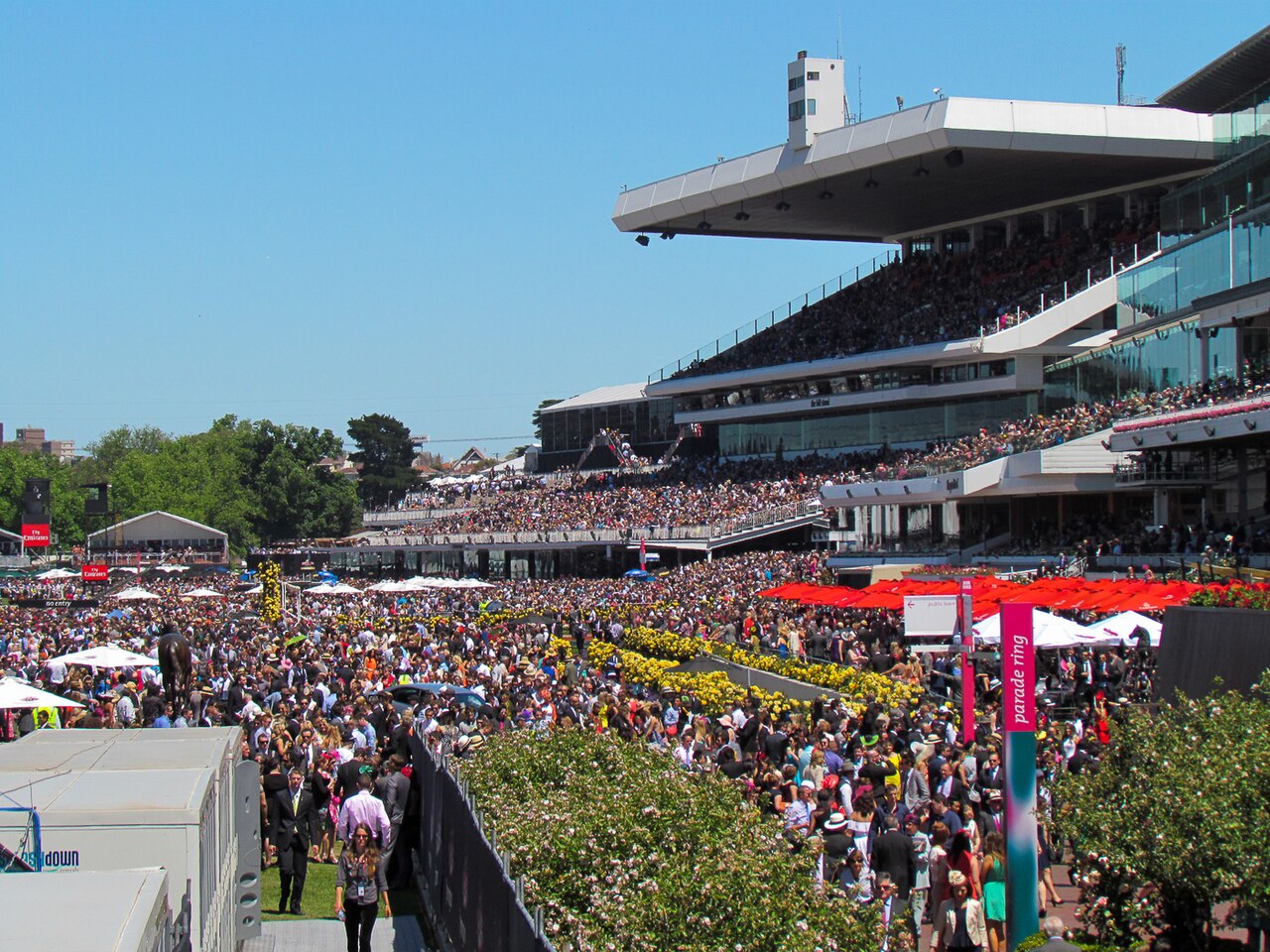
- Cover: Jupiter Firelyte, CC BY 2.0, via Wikimedia Commons. The stands at Flemington Racecourse during the 2013 Melbourne Cup, dated 5 November 2013 on the Commons page. Not a photo from 2026.
- 1946 photo: Simon Studios – Melbourne (Les Haigh Family Collection), public domain, via Wikimedia Commons. Dated 5 November 1946 on the Commons page.
- Makybe Diva statue: osedgman, CC BY 2.0, via Wikimedia Commons. Dated 13 March 2010 on the Commons page.
- Diagrams: drawn by MELB NOTE from the sources above.
Scope: Wikipedia is community-edited and has some internal inconsistencies, noted above. This post gives no tips, odds, field, race time or 2026 prize money. For the day’s schedule see the VRC and our guides. None of the photos is from the 2026 race.
Related guides
- Melbourne Cup Day 2026: Date, Public Holiday and How to Get to Flemington
- Melbourne Cup Carnival 2026: Dates for Derby Day, Cup Day, Oaks Day and Stakes Day
- Victorian Public Holidays 2026 and 2027: Dates for Melbourne, Including Cup Day and Christmas
- Melbourne Weather by Month: Temperatures, Rain and the Four Seasons Reputation


