Melbourne Notes
By MELB_NOTE
The short answer
Melbourne is in Victoria, which uses Eastern Standard Time: AEST, UTC+10:00, in winter. Victoria also uses daylight saving, which adds one hour and gives AEDT, UTC+11:00, between the first Sunday in October and the first Sunday in April. By that rule, as of 19 October 2026 Melbourne is on daylight saving time (AEDT, UTC+11:00). This guide does not show a live clock, so check a clock for the current time.
Search for “melbourne time” and you want one answer: what the clock says, and how it compares with the rest of the country. A guide cannot show you the current time, but it can explain the rules behind it. This one sets out what Wikipedia’s Time in Australia and Daylight saving time in Australia say about Melbourne’s time zone, when daylight saving runs, and how far ahead of other states Melbourne is in each season. We read both articles on 19 October 2026 (Melbourne).
30-second summary
- Victoria uses Eastern Standard Time: AEST, UTC+10:00, and AEDT, UTC+11:00, during daylight saving.
- Daylight saving runs from the first Sunday in October to the first Sunday in April. The change happens at 02:00 local standard time, which becomes 03:00.
- Derived from that rule, the 2026-27 period is 4 October 2026 to 4 April 2027, so Melbourne is on AEDT as of 19 October 2026.
- In summer Melbourne is 1 hour ahead of Queensland, 30 minutes ahead of South Australia, 1 hour 30 minutes ahead of the Northern Territory and 3 hours ahead of Western Australia.
- New South Wales, the ACT and Tasmania keep the same time as Melbourne all year.
Melbourne runs on Eastern time, UTC+10 in winter and UTC+11 in summer
According to Wikipedia, Australia uses three main time zones: Australian Western Standard Time (AWST, UTC+08:00), Australian Central Standard Time (ACST, UTC+09:30) and Australian Eastern Standard Time (AEST, UTC+10:00). Wikipedia says time is regulated by the state governments, and that Victoria uses Eastern Standard Time. Wikipedia does not give Melbourne a separate time zone, so in this guide “Melbourne time” means Victoria’s time.

Wikipedia adds that some states use daylight saving time (DST), which puts clocks forward by one hour between the first Sunday in October and the first Sunday in April, in the south and south-east. New South Wales, Victoria, Tasmania, Jervis Bay Territory and the ACT switch to Australian Eastern Daylight Time (AEDT, UTC+11:00). South Australia switches to Australian Central Daylight Time (ACDT, UTC+10:30). Queensland, Western Australia and the Northern Territory do not use daylight saving.
So Victoria has two settings, and the two together are what people mean by “Eastern time” in Melbourne.
- Winter: AEST, UTC+10:00.
- Summer (daylight saving): AEDT, UTC+11:00.
Daylight saving starts on the first Sunday in October and ends on the first Sunday in April
Wikipedia’s Daylight saving time in Australia says daylight saving in the south-eastern states and South Australia now starts on the first Sunday in October and finishes on the first Sunday in April of the next year. Officially the change takes place at 02:00 local standard time, which becomes 03:00 daylight saving time, on the appropriate Sunday. For Victoria, the start date has been the first Sunday in October since the 2008-09 season.

The 2026-27 dates. We worked these out ourselves from the rule above. They are calendar arithmetic, checked with a short Python script, and not read from an official notice. The first Sunday in October 2026 is 4 October 2026, and the first Sunday in April 2027 is 4 April 2027. On that basis, as of 19 October 2026 Melbourne is on daylight saving time (AEDT, UTC+11:00).
Who sets the dates. Wikipedia says that in Victoria, South Australia, Tasmania and the ACT the start and end dates are officially determined by proclamations, declarations or regulation made by the Governor or the responsible minister. We did not read the Victorian Government pages, so check the official Victorian Government notice for the exact dates each year.
The older rule. Until 2007, Wikipedia says, most states began daylight saving on the last Sunday in October and ended it on the last Sunday in March. In 2007-08, Tasmania started on the first Sunday in October while the ACT, New South Wales, Victoria and South Australia started on the last Sunday in October. Wikipedia lists Victoria as observing daylight saving in 1917, in 1942 to 1944, and since 1971.
How far ahead of other states Melbourne is depends on the season
Because states do not all use daylight saving, the gap between Melbourne and the rest of the mainland changes with the season. Wikipedia says that in the Australian summer the mainland’s three standard zones become five time zones: South Australia moves to UTC+10:30 and the south-eastern states move to UTC+11:00, diverging from Queensland.
The table shows the gaps. They are our own arithmetic from the UTC offsets in Wikipedia, not figures Wikipedia states. We use state and territory names because Wikipedia lists the zones that way.

- Queensland: 1 hour behind Melbourne in summer, the same time in winter.
- South Australia: 30 minutes behind in both seasons.
- Northern Territory: 1 hour 30 minutes behind in summer, 30 minutes behind in winter.
- Western Australia: 3 hours behind in summer, 2 hours behind in winter.
- New South Wales, the ACT and Tasmania: the same time as Melbourne all year, because they observe daylight saving on the same dates according to Wikipedia’s table.
As of 19 October 2026, with Melbourne on AEDT by the rule above, the summer column applies.
Standard time is recent: the colonies adopted it in 1895
Wikipedia says standard time was introduced in Australia in the 1890s. Before that, each colony followed its own time, set by local observatories. The colonies’ time zone legislation took effect in February 1895, and clocks were set ahead of Greenwich Mean Time (GMT) by 10 hours in New South Wales, Victoria, Queensland and Tasmania. Wikipedia describes the Australian colonies as “among the last English-speaking countries to adopt” standard time.

One 1899 detail ties another colony’s time to Melbourne’s. According to Wikipedia, South Australia advanced Central Standard Time by thirty minutes in May 1899 after lobbying by businesses that wanted to be closer to Melbourne time, and by sportspeople who wanted more evening daylight.
Wikipedia also says all jurisdictions adopted UTC as the standard from 1 September 2005. Before that the standard was GMT.
Questions people ask
Is Melbourne ahead of Sydney?
No, they keep the same time all year. According to Wikipedia, New South Wales and Victoria both observe daylight saving from the first Sunday in October to the first Sunday in April.
Does Melbourne have daylight saving?
Yes. Wikipedia says Victoria is among the states that switch to AEDT (UTC+11:00) between the first Sunday in October and the first Sunday in April.
What time zone is Melbourne in?
Victoria uses Eastern Standard Time. That is AEST (UTC+10:00) in winter and AEDT (UTC+11:00) during daylight saving. As of 19 October 2026, by the rule above, Melbourne is on AEDT.
When do the clocks change in 2026-27?
By the rule, daylight saving started on Sunday 4 October 2026 and ends on Sunday 4 April 2027. These dates are derived by us from the first-Sunday rule, not read from an official notice, so check the official Victorian Government notice.
Does Queensland have daylight saving?
No. Wikipedia lists Queensland, Western Australia and the Northern Territory as not using daylight saving, so Queensland is 1 hour behind Melbourne in summer and the same time in winter.
Sources and scope
Both articles were read on 19 October 2026 (Melbourne). We did not read the Victorian Government pages.
Photo credits:
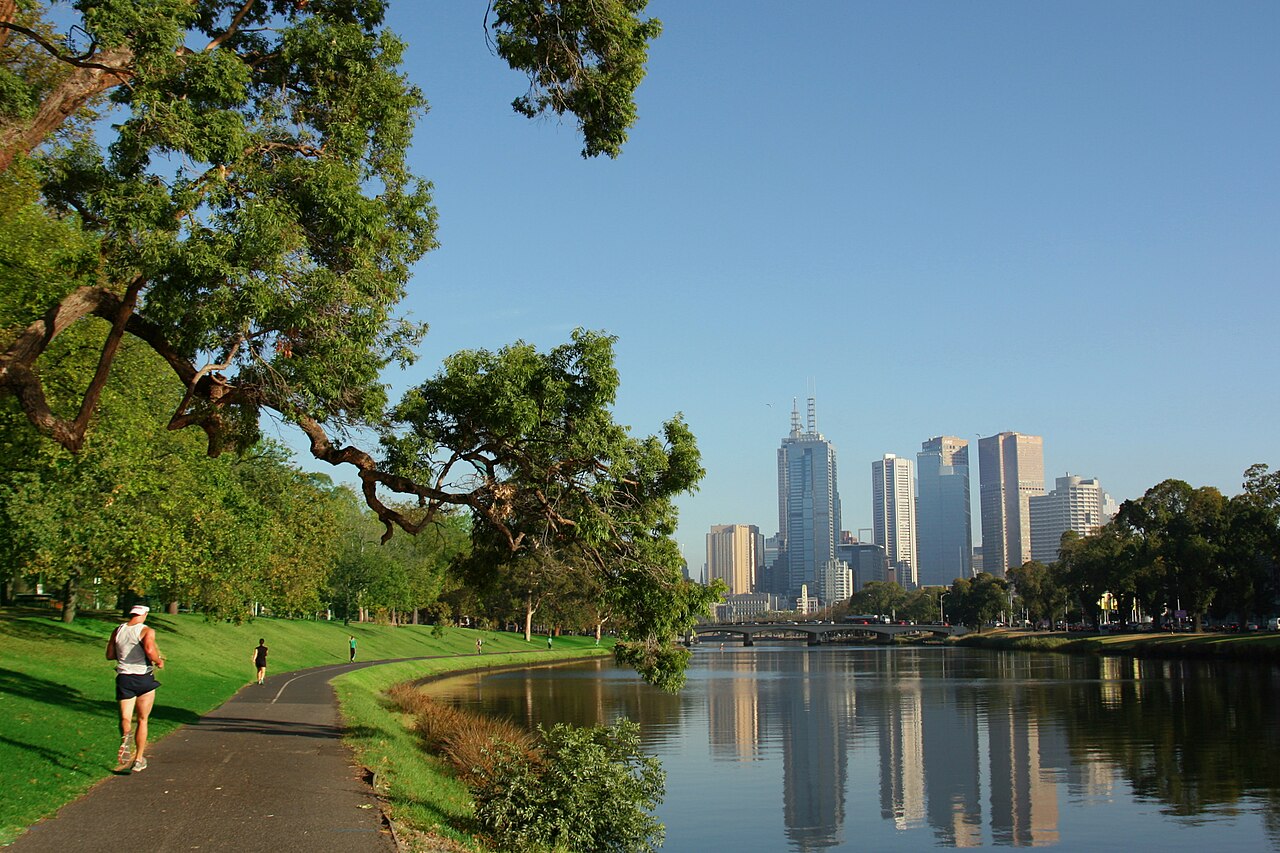
- Cover: Ari Bakker, CC BY 2.0, via Wikimedia Commons. The Commons page notes the image was modified (saturation, contrast, toning).
- Flinders Street Station clocks: Rexness, CC BY-SA 2.0, via Wikimedia Commons.
- Melbourne Town Hall clock tower: Rexness, CC BY-SA 2.0, via Wikimedia Commons.
- Diagrams: drawn by MELB NOTE from the sources above.
Scope: This guide explains the time zone rules as Wikipedia describes them. It does not show a live clock, so check a clock for the current time. The 2026-27 daylight saving dates and the gaps between states are our own arithmetic from the rule and the UTC offsets, not official notices. It gives no prices and no travel advice.


