Tea
By MELB_NOTE
The short answer
Pu-erh (also written pu’er) is a fermented tea traditionally produced in Yunnan Province, China, from the large-leaf Yunnan tea plant. According to Wikipedia, it is truly fermented by microbes, which most teas called fermented are not. It comes in two styles: traditional “raw” (sheng) and modern accelerated “ripe” (shou or shu). It is often pressed into cakes, bricks and other shapes.
This is a plain beginner guide to pu-erh: what it is, why it is called fermented, how raw and ripe differ and what the shapes mean. We read Wikipedia’s Pu’er tea article and its Fermented tea article on 24 October 2026 (Melbourne) and used no other source. Wikipedia is community-edited, so its text may change. Where the sources are silent, we say nothing.
30-second summary
- Pu-erh is a fermented tea from Yunnan, made from the large-leaf Camellia sinensis var. assamica.
- In Chinese tea terms, fermentation means microbial fermentation called wet piling, not just oxidation.
- Raw (sheng) is the traditional, longer style. Ripe (shou or shu) uses a faster wet-piling step developed in 1973.
- Pu-erh is pressed into cakes, tuocha, bricks and other shapes, and it can be stored and aged.
- The name comes from the old tea-trading town of Pu’er in Yunnan.
Pu-erh is a Yunnan tea that is fermented by microbes, not just oxidised
Wikipedia describes pu’er, also spelled pu-erh, as a variety of fermented tea traditionally produced in Yunnan Province, China. It is made from the leaves of the Yunnan tea plant, Camellia sinensis var. assamica, a large-leaf variety native to Yunnan. Wikipedia says it differs from Yunnan black tea (dianhong) in going through a complex fermentation process.

The word “fermented” needs care. In Chinese tea terminology it means microbial fermentation, called wet piling, applied after the leaves are dried and rolled. The tea also continues to oxidise in a controlled way. Wikipedia notes that most teas called fermented are actually oxidised by the leaves’ own enzymes, whereas pu’er is fermented by molds, bacteria and yeasts on the leaves, so it is truly fermented.
Because of this, pu-erh is often translated as “dark tea”, to tell it apart from English “black tea”. Chinese calls what English speakers call black tea “red tea”.
One more difference from green tea is the picking. Wikipedia says pu’er uses one bud and three to four leaves, against one bud and one to two leaves for green tea.
Raw and ripe pu-erh differ in how they are aged
Wikipedia describes two styles: the traditional, longer “raw” (sheng) and the modern, accelerated “ripe” (shou or shu). Both start from maocha, or rough tea. Maocha is made by killing green (pan-roasting), rolling and sun drying. The leaves are not hot-air dried after pan-roasting, so a little enzyme activity remains. Maocha can be sold loose or pressed.

Ripe pu-erh uses wòduī, wet piling. Wikipedia says it was developed in 1973 by the Kunming Tea Factory and adopted by the Menghai Tea Factory shortly after, with mass production of ripe pu-erh from 1975. Ripening typically takes 45 to 60 days on average, according to Wikipedia.
In English, ripe tea is sometimes called “cooked”. Wikipedia says that is a translation quirk, because the Chinese word means both fully cooked and fully ripened. The process is piling, dampening and turning, akin to composting. Poor control gives a compost-like aroma. Some traditionalists dispute the legitimacy of ripe pu-erh.
Cakes, bricks and tuocha are shapes of the same tea
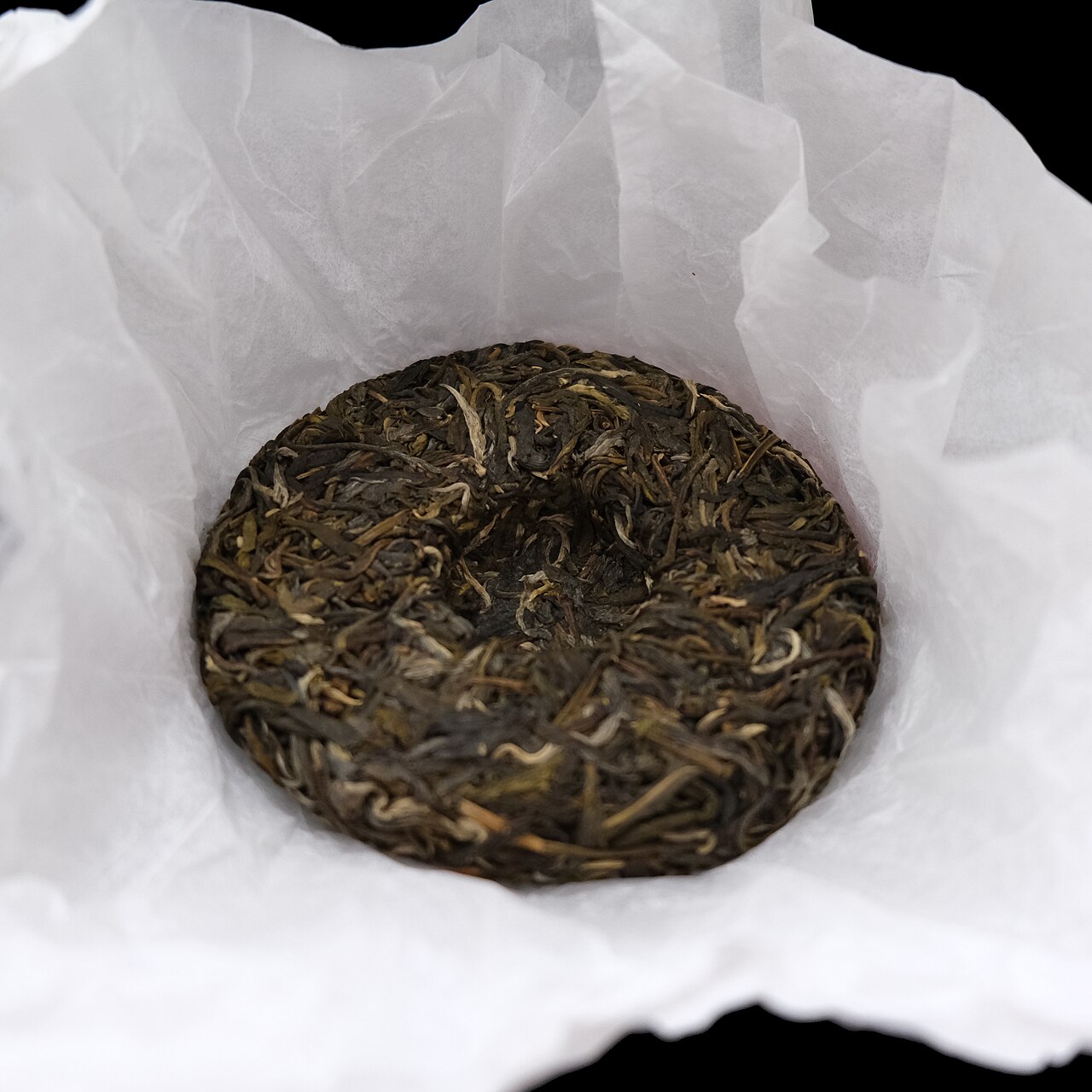
Pu-erh can be pressed. Wikipedia says the leaves are lightly steamed to soften, then bagged or put in moulds and pressed by hydraulic press or by hand with a stone. The pressed tea is air dried on shelves, then wrapped. The dimple on the back of a cake comes from the cloth knot.

Wikipedia lists the common shapes in a table. The bing, also called a cake or disc, is common at 357 g, 400 g and 500 g, and seven cakes are packaged together, hence the name qizi bing. The tuocha is a bowl or nest shape, and the name possibly comes from its top-like shape or from the Tuo River trade route. There are also bricks, squares, mushroom shapes (generally produced for Tibetan consumption) and the dragon pearl, a small single-serving ball of 5 to 10 g.

Wikipedia’s table lists all of these as shapes of pu-erh, so they are different forms of the same tea.
Pu-erh is named after a trading town and has a long Yunnan history
The name comes from the old tea-trading town of Pu’er, now Ning’er Town in Pu’er City, Yunnan. Pu’er County was renamed Simao in 1950, and the city was renamed Pu’er in 2007. “Pu-erh” is a Wade-Giles variant of the same name. Wikipedia says that as of 2008 only the large-leaf Yunnan variety can be called pu’er.
The history is long. According to Wikipedia, the Bulang and Dai people have produced pu’er at Jingmai Mountain since at least the 10th century, and Jingmai Mountain was inscribed as a UNESCO World Heritage Site in 2023. Demand surged in Hong Kong in the 1950s, and the ripe process followed in the 1970s.
Pu-erh can also be stored and aged, like wine, in non-airtight containers, and it is standard to label it with the year and region. Wikipedia’s Fermented tea article says raw pu-erh may be aged for years, up to 50 years in some cases, and ripe for 10 to 15. It adds that experts disagree on the optimal age. Some collectors think ripe pu-erh should not age beyond a decade. On the wider history of dark tea, the Fermented tea article says the early story is unclear: one legend has caravan tea soaked by rain on the Silk Road, and other accounts credit the Ming dynasty in the 15th and 16th centuries.
It is one of several fermented teas
Pu-erh belongs to a wider group. Wikipedia’s Fermented tea article calls them fermented, post-fermented or dark tea, and in Chinese hei cha, literally “black tea”. Fermentation runs from several months to many years, the leaves and liquor darken, and the taste mellows, reducing astringency and bitterness. It is mainly done by molds, and the species involved is still debated.
In China the producing regions include Yunnan (pu’er), Hunan, Hubei, Guangxi, Sichuan, Anhui, Shaanxi and the Tibet region. Shapes include bricks, cakes, bamboo logs, baskets and bird nests.
Elsewhere, Wikipedia lists Japan (Toyama piled tea and pickled teas) and Korea among other places with fermented teas. In Myanmar, lahpet and in northern Thailand, miang are eaten as pickled teas. Tibetans and Central Asians boil pu-erh or other fermented teas with yak butter, sugar and salt to make yak butter tea.
If you want to compare with other styles, see White Tea for Beginners: What It Is, the Main Types and What We Can and Cannot Say About It, Oolong Tea for Beginners: Styles, Taste, Caffeine and How to Brew or our Tea Guide: Beginner Tea Types and Brewing.
Questions people ask
Is pu-erh black tea?
No. Wikipedia describes pu-erh as a fermented or dark tea. English “black tea” is called “red tea” in Chinese, and pu-erh is often translated “dark tea” to tell them apart.
What is the difference between raw and ripe pu-erh?
Raw (sheng) is the traditional, longer style. Ripe (shou or shu) is the modern accelerated style that uses wet piling, which typically takes 45 to 60 days on average according to Wikipedia.
Does pu-erh get better with age?
Wikipedia says pu-erh can be stored and aged like wine, but experts disagree on the optimal age. It does not give a verdict, so we do not either.
Why is pu-erh pressed into a cake?
Wikipedia describes pressing as part of how pu-erh is shaped and packaged, and lists cakes, tuocha, bricks, squares, mushrooms and dragon pearls. It does not give a single reason for the cake.
Why is it called fermented?
In Chinese tea terminology fermentation means microbial fermentation, called wet piling. Most teas called fermented are actually oxidised by the leaves’ own enzymes, but pu-erh is fermented by molds, bacteria and yeasts on the leaves.
Sources and scope
Both articles were read on 24 October 2026 (Melbourne). We used no other source. Wikipedia is a community-edited source, and its text may change.
Photo credits:
- Cover: Ash Crow, CC BY-SA 4.0, via Wikimedia Commons. A pressed pu-erh cake opened in white paper wrapping; the Commons file calls it a raw pu-erh tea cake.
- Pressed pu-erh cake from the front: Shizuha (静葉), CC BY-SA 3.0, via Wikimedia Commons.
- Small foil-wrapped pieces: Fumikas Sagisavas, CC0, via Wikimedia Commons.
- Diagrams: drawn by MELB NOTE from the sources above.
Scope: This guide summarises what Wikipedia says about pu-erh and fermented tea. It gives no brewing temperatures, amounts or times, no health claims, no prices and no buying advice.


