Tea
By MELB_NOTE
The short answer
White tea is a group of styles made from young or minimally processed leaves of the Camellia sinensis plant. Wikipedia says there is no generally accepted definition, but that most definitions agree it is not rolled or oxidized. It is made mainly in China, mostly in Fujian province. Wikipedia gives no brewing instructions, so follow the label on the pack you buy.
This is a plain beginner guide to white tea: what it is, how it is made, the main Chinese grades and what can and cannot be said about it. We read Wikipedia’s White tea article on 22 October 2026 (Melbourne) and use only that source. Where the source is vague or silent, we say so.
30-second summary
- White tea generally means young or minimally processed Camellia sinensis leaves, but there is no generally accepted definition.
- The base process is withering then drying. Most definitions say it is not rolled or oxidized.
- Brewed white tea is pale yellow. The name comes from fine silvery-white hairs on the unopened buds.
- In China the four grades are Silver Needle, White Peony, Gongmei and Shoumei, from just buds to many leaves.
- Wikipedia gives caffeine estimates that range widely and no brewing instructions. Check the pack label.
White tea is lightly processed tea, but nobody agrees on one exact definition
According to Wikipedia, white tea “may refer to one of several styles of tea which generally feature young or minimally processed leaves of the Camellia sinensis plant.” The same article says there is currently no generally accepted definition of white tea and very little international agreement on how it can be defined.

Wikipedia lists three kinds of definition. One is tea that is merely dried with no additional processing, very close to the natural state of the plant. Another is tea made from buds and immature leaves picked shortly before the buds fully opened, traditionally withered and dried under the sun. A third includes buds and very young leaves that have been steamed or fired before drying.
Most definitions agree that white tea is not rolled or oxidized. Wikipedia describes its flavour as “characterized as lighter than that of most green or traditional black teas”.
Despite the name, brewed white tea is pale yellow. The name comes from the fine silvery-white hairs on the unopened buds, which give the plant a whitish appearance. Unopened buds are used for some types.
It is made by withering and drying, with no rolling or oxidation
Wikipedia gives the base process as three steps: fresh tea leaf, withering, then drying by air, solar or mechanical means. White tea belongs to the group of teas that do not require panning, rolling or shaking. The article says raw material selection is “extremely stringent”: only young leaves with much fine hair give good-quality white tea of high pekoe value.

It is produced primarily in China, mostly in Fujian province. More recently it has also been made in Taiwan, Eastern Nepal, Thailand, Galle (Southern Sri Lanka) and northeast India. Wikipedia also says some tea from wild Camellia taliensis in Yunnan is made with white tea processing.
The history is unclear. Wikipedia says what is known today as white tea may have come into creation in the last two centuries, and that scholars and tea merchants disagree on when production began. It may have first appeared in English publication in 1876, where it was categorised as a black tea because the leaves are not steamed first, as they are in making green tea, to denature intrinsic oxidative enzymes. It is often sold as Silvery Tip Pekoe, China White or Fujian White.
The four Chinese grades run from all buds to many leaves
Wikipedia describes a four-level quality hierarchy for Chinese white tea. At the top is Baihao Yinzhen (Silver Needle), which is just the bud. Bai Mudan (White Peony) is typically one bud and two leaves. Gongmei is similar to Bai Mudan but has three to four leaves. Shoumei (Longevity Eyebrow) is the lowest grade, with many leaves and few buds.

Wikipedia also groups the teas into three main classes: Longevity Eyebrow (shòu méi, typically no buds), White Peony (bái mǔdān, some buds mixed with leaves) and Silver Needle (báiháo yínzhēn, only buds).
Other names appear too. Ya Bao is all buds and comes from Yunnan. Yue guan bai, “moonlight white”, is supposedly dried under the moonlight rather than the sun. White Darjeeling is a Himalayan white.
What Wikipedia says about caffeine and polyphenols
Like black and green tea, white tea is made from Camellia sinensis and contains polyphenols. Wikipedia says these are “thought to be responsible for the health effects of tea”. We make no health claims here. White teas differ in catechins, and Wikipedia says the overall range overlaps with green tea, so some white teas have the same polyphenol concentration as some green teas. It puts the differences down to variety, cultivation and processing.

On caffeine, Wikipedia says it depends on many factors. Estimates for a cup of brewed white tea “range widely, from less than 10 mg to over 50 mg”, and some studies conclude that white tea tends to have less caffeine than green tea. For comparison, Wikipedia quotes USDA figures of 47 mg for brewed black tea, about 29 mg for green and about 38 mg for oolong. The text we read does not give the cup size. Wikipedia also says some studies have failed to prove a relationship between the variety of tea and the caffeine content.
In short, the source gives a wide range and no firm ranking. For a fuller comparison, see our guide, Caffeine in Tea: Black, Green, Oolong and Herbal Compared with Coffee.
How to choose and brew: what the source does not tell us
The Wikipedia article gives no brewing temperature, no steeping time and no leaf amount, so we do not give any either. Follow the instructions on the label of the pack you buy.
If you are deciding between formats, our guide Tea Bags vs Loose Leaf Tea: Which Is Easier to Start With? may help. For another tea style, see Oolong Tea for Beginners: Styles, Taste, Caffeine and How to Brew. For a general overview, see our Tea Guide.
Questions people ask
Is white tea oxidised?
Wikipedia says most definitions agree that white tea is not rolled or oxidized. There is no generally accepted definition, so check the pack for how your tea is described.
Why is it called white tea?
Wikipedia says the name comes from the fine silvery-white hairs on the unopened buds, which give the plant a whitish appearance. Brewed white tea is pale yellow.
Where is white tea made?
Primarily in China, mostly in Fujian province. More recently it is also made in Taiwan, Eastern Nepal, Thailand, Galle (Southern Sri Lanka) and northeast India.
Does white tea have less caffeine than green tea?
Wikipedia says some studies conclude it tends to, but that estimates for a cup of white tea range widely, from less than 10 mg to over 50 mg, and that some studies have failed to prove a relationship between tea variety and caffeine content.
What is Silver Needle?
Silver Needle (Baihao Yinzhen) is the highest of the four Chinese white tea grades in Wikipedia’s description, and it is made from just the bud.
Sources and scope
The article was read on 22 October 2026 (Melbourne). We used no other source. Wikipedia is a community-edited source, and its text may change.
Photo credits:
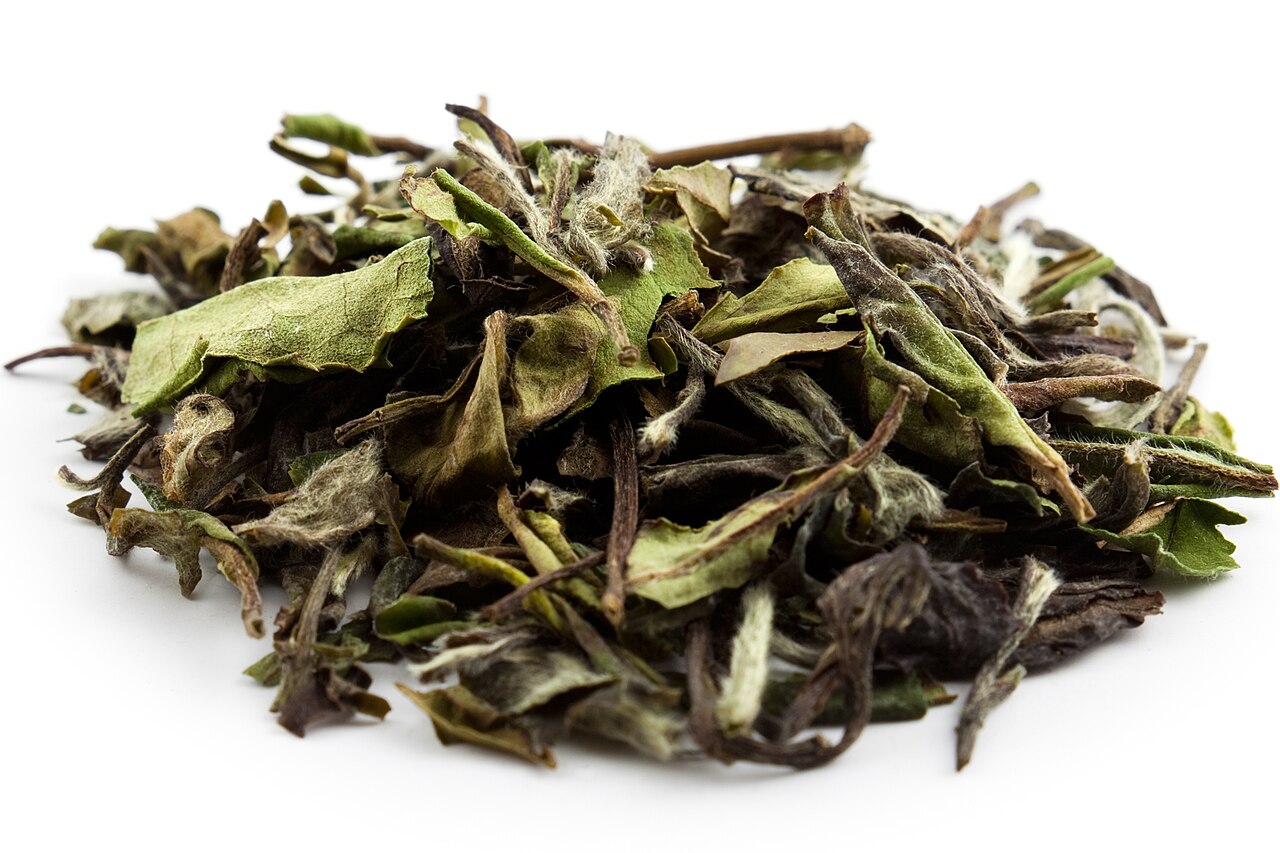
- Cover: soultea.de/André Helbig, CC BY-SA 3.0, via Wikimedia Commons. Dry white tea leaves on a white background; the Commons file name calls the tea Pai Mu Tan.
- Dry white tea in a glass bowl: Pannet, CC BY-SA 4.0, via Wikimedia Commons.
- Pouring brewed white tea: Pannet, CC BY-SA 4.0, via Wikimedia Commons.
- Diagrams: drawn by MELB NOTE from the source above.
Scope: This guide summarises what Wikipedia says about white tea. It gives no brewing temperatures or times, no health claims and no prices or brands.


