On this page
Green and black tea generally begin with leaves from the same tea species. The main difference is processing: green tea is heated early to limit oxidation, while black tea is allowed to oxidise much more before it is dried.
By MELB NOTE Editorial Team · Reviewed 30 July 2026 · No sponsorship or affiliate links
The short answer
Choose green tea when you want to begin with a lighter, fresher or more vegetal direction. Choose black tea when you want a deeper, rounder or more robust direction, especially if you may add milk.
These are broad starting points, not quality rules. Cultivar, origin, season, manufacturing choices and the way you brew a particular tea can move either cup outside the stereotype.
Both usually come from Camellia sinensis, the tea plant.
Green-tea processing limits oxidation early; black-tea processing allows extensive oxidation before drying.
Choose by flavour and use, then follow the specific product’s brewing instructions.
Green tea and black tea at a glance
| Question | Green tea | Black tea |
|---|---|---|
| Where does it start? | Usually leaves from Camellia sinensis | Usually leaves from Camellia sinensis |
| Broad processing path | Heat is applied early to limit enzyme activity and oxidation | Leaves are withered and disrupted so extensive oxidation can develop before drying |
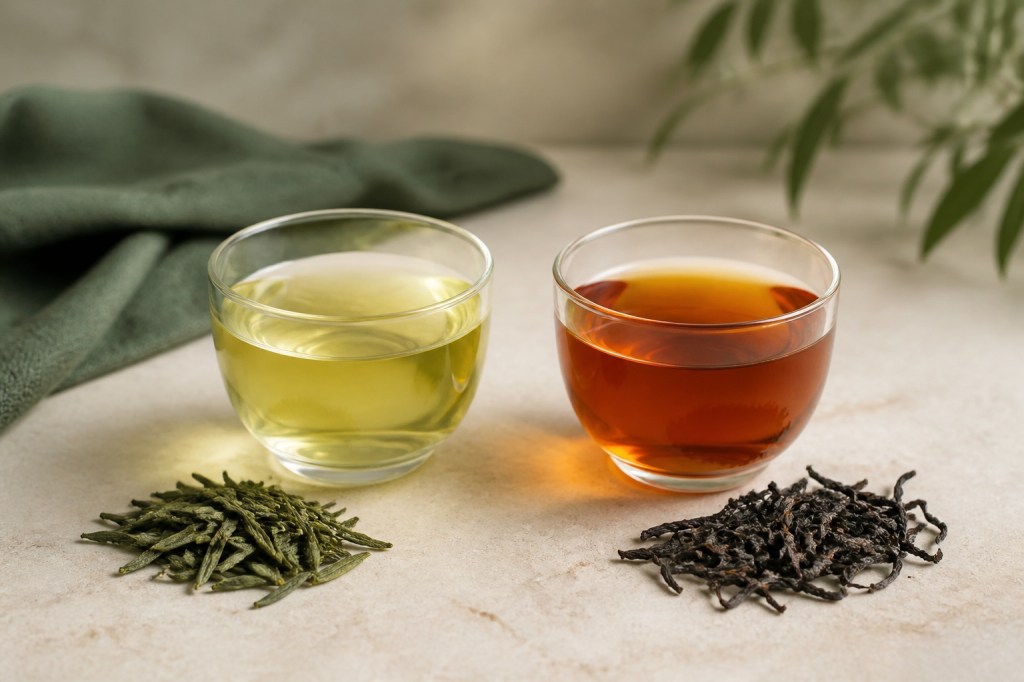
| Common colour direction | Pale yellow-green to deeper green-gold | Copper, amber or reddish brown |
| Broad flavour direction | Fresh, vegetal, marine, nutty or gently toasted | Floral, fruity, malty, honeyed or spicy |
| Easy first use | A clean cup without milk | Plain, with lemon, or—when the tea is full enough—with milk |
| Best brewing baseline | The instructions for the actual tea | The instructions for the actual tea |
The flavour rows describe useful directions, not promises. A steamed Japanese green tea and a pan-fired Chinese green tea can taste very different. A delicate first-flush black tea and a strong breakfast blend can also sit far apart.
How the same tea plant becomes two different teas
Green tea limits oxidation early
After harvest, green-tea makers apply heat relatively early. Steaming and pan-firing are two examples. The heat reduces the activity of enzymes in the leaf and limits the oxidation that would otherwise change its colour and aroma.
This helps preserve a greener appearance and supports the fresh, vegetal or gently toasted directions associated with many green teas. The exact result still depends on the cultivar, growing conditions and every later production step.
Black tea develops extensive oxidation
Black-tea production commonly includes withering and rolling or cutting. Damaging the leaf cells brings their components into contact with oxygen while leaf enzymes are active, allowing extensive oxidation. Drying later stabilises the finished tea.
The leaf darkens and the brewed liquid commonly moves towards copper, amber or reddish-brown tones. Aroma can move towards fruit, flowers, malt, honey or spice. Those words describe a wide family of teas, not one standard flavour.
Which one should you choose?
Start with green tea if:
- you want a lighter or fresher direction;
- you enjoy vegetal, marine, nutty or gently toasted aromas;
- you plan to drink the tea without milk;
- you are happy to follow the product’s brewing guidance closely.
Start with black tea if:
- you want a fuller or deeper direction;
- you enjoy fruit, flower, malt, honey or spice notes;
- you may add milk or lemon;
- you want to explore both delicate single-origin teas and stronger blends.
Milk is not a rule for all black tea. A light, aromatic black tea can be overwhelmed, while a fuller tea may remain clear and balanced. Check the producer’s description and try the tea plain before deciding.
How to brew either tea without memorising a universal recipe
The safest starting point is the instruction supplied with the tea. Leaf size, manufacturing style, intended serving and packaging all affect a useful dose, water temperature and steep time.
- Use the same water and similar cup size for both teas.
- Follow each tea’s own instructions rather than forcing identical temperatures or times.
- Taste each cup plain first before adding milk, lemon or sweetener.
- Change one variable on the next brew if a cup is too strong or astringent—usually time, temperature or leaf amount.
- Record the change that helped so the next cup is easier to repeat.
This is a comparison method, not a MELB NOTE recipe. It avoids pretending that every green tea or every black tea should be brewed the same way.
Optional deeper layer
Go deeper: is black tea fermented or oxidised?
In several tea cultures, familiar classification systems describe green tea as “unfermented” and black tea as “fermented”. You may therefore see both words in shops and introductory guides.
For the central change in conventional black-tea manufacture, oxidation is the clearer technical word. Leaf cells are disrupted, oxygen is available and enzymes from the leaf help transform its components. This is different from a process driven mainly by microbes, as in some post-fermented teas.
Using oxidised does not mean every black tea follows one identical process or reaches one measurable endpoint. It is a practical category description, while cultivar and manufacturing choices still shape the final cup.
What about caffeine?
Tea colour alone is not a precise caffeine calculator. The US Food and Drug Administration publishes higher typical category values for black tea than green tea in one 12-fluid-ounce comparison, but it also states that amounts in specific products and container sizes vary.
If caffeine matters to you, check the product information when it is available and compare the actual serving you drink. Do not assume that every black tea has more caffeine than every green tea.
Is one healthier?
This guide does not rank green and black tea by health value. A broad tea category is too coarse a basis for choosing a health “winner”, and this article’s verified sources are being used for product definitions, processing and caffeine scope—not disease treatment or prevention.
Choose the tea that suits your flavour, use and caffeine needs. For advice related to pregnancy, medication, a medical condition or caffeine sensitivity, use guidance from an appropriate health professional.
Frequently asked questions
Do green tea and black tea come from the same plant?
Generally, yes. Both are made from leaves of Camellia sinensis. That does not mean every product uses the same cultivar, growing region or manufacturing method.
Why is black tea called red tea in some languages?
English black tea points to the dark processed leaf, while names translated as red tea often point to the reddish colour of the brewed liquid. In this context, they describe the same broad tea category.
Is green tea completely unoxidised?
Oxidation is limited early is more careful than saying it is absolutely zero. Heat is applied early to reduce enzyme activity, but detailed processes vary among producers and tea styles.
Does black tea always contain more caffeine?
No fixed rule predicts every cup. Typical category figures may be higher for black tea, but the product, serving size and preparation matter. Check product information when caffeine is important to you.
Which tea is better with milk?
A fuller black tea is often the easier starting point because its aroma and body may remain noticeable after milk is added. Delicate black teas can be overwhelmed, and green tea is not automatically unsuitable; choose by the specific tea and the drink you want.
Sources and scope
- ISO 11287:2011, Green tea — Definition and basic requirements — public scope for green-tea plant material and basic product requirements
- ISO 3720:2011, Black tea — Definition and basic requirements — public scope for black-tea plant material and basic product requirements
- UNCTAD, Tea INFOCOMM — broad tea classification and the contrast between limited and extensive oxidation
- Japan Ministry of Agriculture, Forestry and Fisheries, Tea types with different tastes and aromas — shared tea-plant scope, early heating, enzyme action and colour change
- US Food and Drug Administration, Spilling the Beans: How Much Caffeine is Too Much? — typical category examples and the warning that specific products and serving sizes vary
Scope: These sources support broad product definitions, processing and caffeine variability. They do not make every origin, cultivar, flavour or brewing method identical. Reviewed 30 July 2026.



 MELB NOTE