On this page
By MELB NOTE Editorial Team · Reviewed 10 August 2026 · No sponsorship or affiliate links
The short answer
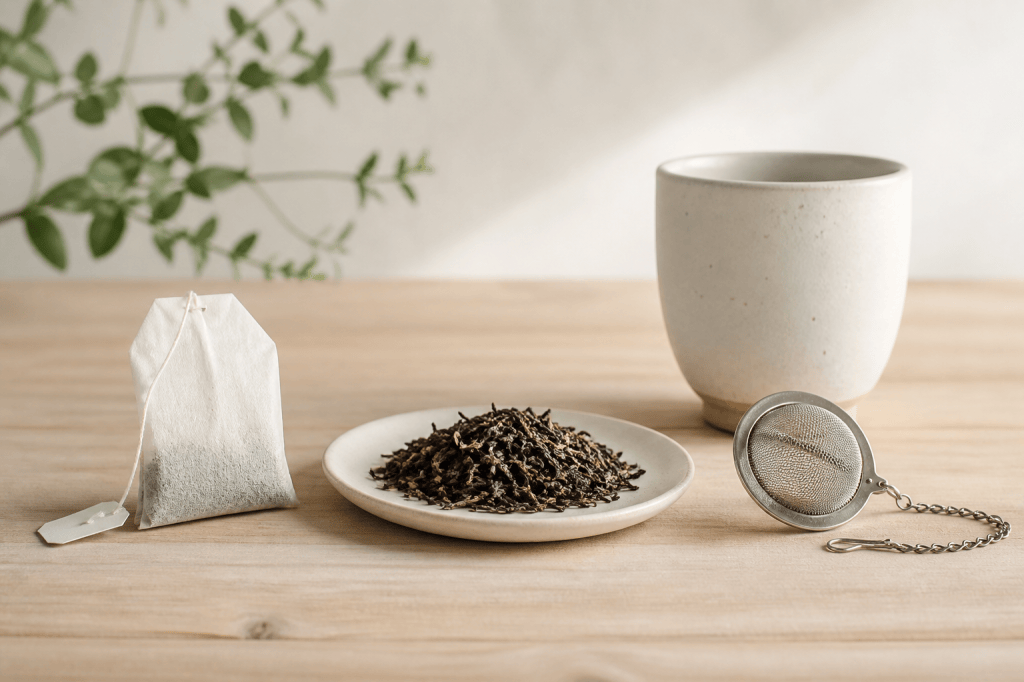
Choose a tea bag when you want a portion that is already contained for you. Choose loose leaf tea when you are happy to decide the amount and use a strainer or another way to remove the leaves.
Neither form is automatically better. The useful next step is to read the actual packet for its ingredients, material, allergens and preparation instructions.
A bag is a packaging form that contains a portion of tea.
Loose leaf adds two decisions: how much tea to use and how to remove it after steeping.
The packet is the method. Do not copy one product’s water, time or quantity to every tea.
The difference is a preparation task, not a quality score
The UK Tea & Infusions Association describes loose-leaf packets and tea bags as different packing forms. That is the stable comparison: one is supplied in bags, while the other is supplied for the reader to portion.
It does not prove that a bagged tea is lower quality, that loose leaf is always fresher, or that one material is safer. Those claims depend on a particular product and need their own evidence.
Tea bags and loose leaf at a glance
| Question | Tea bag | Loose leaf tea |
|---|---|---|
| First preparation task | Put the supplied bag in the cup or pot | Measure a portion of the supplied tea |
| Removing tea after steeping | Lift out the bag | Strain, remove or pour away from the leaves |
| What to check on the packet | Ingredients, bag material and instructions | Ingredients, leaf amount and instructions |
| What the form cannot promise | Taste, quality, safety or fixed brew time | Taste, quality, safety or fixed brew time |
A simple first-cup checklist
- Read the ingredients first. The format does not tell you every plant in a blend.
- Use the manufacturer’s instruction for that product. A named teabag and a named loose-leaf tea can require different amounts, water and time.
- Choose the tool you have. A cup, pot or strainer can change which format feels easier today.
- Change only one thing next time if the cup is not to your preference: amount, time or another instruction-supported variable.
Practical takeaway: Pick the workflow you will actually repeat. A bag reduces the first measuring step; loose leaf gives you a measuring-and-straining step to manage.
Go deeper: why the packet is more useful than the format alone
Can I use the same brewing rule for every bag or every loose tea?
No. One named Osulloc teabag product and one named loose-leaf product carry their own instructions.
Those pages demonstrate that preparation guidance belongs to the product, not to a broad packaging label. Follow the packet rather than treating a comparison article as a universal recipe.
Frequently asked questions
Is loose leaf always better quality than tea bags?
This guide does not make that ranking. Packaging form alone cannot establish the quality of every tea product.
Do tea bags always brew more quickly?
Not as a universal rule. Use the instructions supplied with the specific product and avoid assuming a fixed time from its format alone.
Which form is safer?
Safety, allergy and material questions need product-specific information. Check the label and seek qualified advice when an ingredient, allergy or medical concern matters.
Sources and scope
- UK Tea & Infusions Association — Packed, Distributed & Traded
- Osulloc — Sweet Honey Black Tea
- Osulloc — Sejak loose-leaf tea time
Scope: These sources establish packaging and named-product preparation examples. They do not support a universal taste, quality, safety, material, sustainability or steep-time verdict. Reviewed 10 August 2026.


 MELB NOTE