Coffee Guide
By MELB_NOTE

The short answer
A moka pot makes strong, small coffee on the stove, but it is not espresso. It pushes hot water up through the coffee with steam pressure from its own sealed base. An espresso machine forces water through a tightly packed puck at about 9 bar in about half a minute. The moka pot runs at a fraction of that pressure, uses much more water per gram of coffee and runs hotter at the end. The result is a bold cup with little or no crema. It is cheap, simple and good for milk drinks at home.
This guide covers the difference in plain terms. If a moka cup tastes harsh, our guide to coffee bitterness in depth explains why. For other ways to brew at home, see coffee machine types.
30-second summary
- A moka pot uses steam pressure from the water in its base. Espresso uses a pump at about 9 bar.
- In one laboratory test, the pressure in a moka pot base peaked at just over 2 bar.
- In one comparison, a moka pot used about 15 ml of water per gram of coffee. Espresso used about 4 ml.
- Moka coffee is strong, but it was less concentrated than espresso in that test.
- A moka pot makes little or no crema.
- The final, hottest phase of the brew can add harsh bitterness. Taking the pot off the heat when the gurgling starts is a sensible habit.
A moka pot uses steam pressure from its own base

A moka pot has three main parts. The base holds water. The funnel holds the ground coffee. The upper chamber catches the finished brew.
Navarini et al. (2009) describe how it works. The moka “uses the steam pressure, produced by the water contained in an autoclave-type aluminum kettle heated by an external source, to force upwards water itself through a roasted and ground coffee bed contained in a funnel-shaped filter.” A tube then carries the brew into the upper vessel.
The design is old. According to the same paper, aluminium technologist Alfonso Bialetti invented the stove-top maker in 1933. His son Renato began making it industrially in 1946 as the “Moka Express”. The paper reports more than 105 million units sold.
Many people believe the water must boil at 100°C to push water up. The study says otherwise: “extraction commences at pretty low temperatures and depends on the initial amount of dry air in the kettle.” In their tests, the water in the base was only about 69 to 70°C on average when the first coffee came through. A clear pressure rise began at about 90°C.
Espresso is defined by about 9 bar of pump pressure and a short shot

Espresso has a clear definition. Navarini et al. (2009) cite a standard in which espresso is prepared “by means of hot (90 ±5°C) water pressure (9 ±2 bar) applied for a short time (30 ±5 s) to a compact roast and ground coffee cake (6.5 ±1.5 g) by a percolation machine, to obtain a small cup of a concentrated foamy elixir.”
Real shots vary. In Gloess et al. (2013), a semi-automatic machine made a double espresso from 16 g of coffee. It produced 2 × 30 ml in about 29 seconds at 92°C and 9 bar.
Three things define espresso: high pressure, a short time and a compact bed of fine coffee. A moka pot differs on the first of these, as the next section shows.
The moka pot works at a fraction of espresso pressure
In one laboratory test, the pressure in the base of a 3-cup moka pot peaked at just over 2 bar. That was near the end of the brew, with the pot on a 400 W heater (Navarini et al. (2009), Figure 3). This is a single test, not a rule for every pot. Even so, it is well under the 9 bar of espresso.
The brew also looks different. The study notes that moka coffee lacks “the foam layer typical of true Italian espresso”. In other words, expect little or no crema.
The name “Moka Express” can mislead. The authors point out that espresso “is prepared by very different coffee machine and it is also organoleptically very different from moka coffee brew”.

Moka coffee is strong, but more dilute than espresso
Outside Italy, the moka pot is often called a stove-top espresso maker. The numbers show why that name is loose. In Gloess et al. (2013), the moka pot (a Bialetti Moka Express, 3-cup) used 7.5 g of coffee for about 110 ml of brew. That is roughly 15 ml of water per gram. The espresso used 16 g for 60 ml, about 4 ml per gram.
The authors make the same point: “The mocha extraction is generally regarded as espresso while having a water to coffee ratio like a lungo.” A lungo is a longer coffee made with more water.
The measured concentration of compounds was highest in the espressi. The moka came next, and the lunghi came last. Caffeine followed the same order. So per millilitre, the moka coffee was less concentrated than espresso in that test.
The moka pot also had the highest extraction yield of the nine methods, at 31.2%. The authors link this “most probably” to the high extraction temperature in the percolator. Extraction yield is the share of the ground coffee that dissolves into the water. Navarini and colleagues report moka yields from 27.6% to 31.9%. They note that 18% to 22% is often proposed as most acceptable, and that above 24% is considered over-extracted. Treat these as commonly cited ranges, not a law. For more on strength and yield, see coffee bitterness in depth.
| Feature | Moka pot | Espresso machine |
|---|---|---|
| Heat source | Stove (gas, electric or induction with an adapter, depending on the pot) | Electric pump machine |
| Pressure | Peak of just over 2 bar in one lab test | About 9 bar (plus or minus 2) |
| Coffee and water in the Gloess test | 7.5 g to about 110 ml (about 1:15) | 16 g to 60 ml (about 1:4) |
| Brew time in the Gloess test | About 224 seconds | About 29 seconds |
| Crema | Little or none | The foam layer typical of espresso |
| Cost and equipment | Usually lower: one pot and a heat source | Usually higher: a machine and a grinder |
| Best for | A strong cup and milk drinks at home | True espresso, crema and café-style drinks |
The brew times, ratios and pressures in the table come from single studies. Your own pot and machine may differ.
The last, hottest part of the brew can add harsh bitterness
Navarini et al. (2009) split the moka brew into two phases. The first is a regular extraction phase, driven by pressure in the closed base. The second comes when the water level reaches the end of the funnel. The remaining water then evaporates intensely. This final phase is announced by the familiar gurgling or rattling sound. The authors call it the “strombolian” phase, after the way a volcano behaves.
In their tests, the water in the base reached about 117°C (400 W) to 121°C (600 W) by the start of that phase. The authors explain that high-temperature fluids passing through the coffee are “more efficient in solubilizing less soluble compounds, generally conferring bitterness and astringency”. They add that “the higher the pressure and temperature, the higher the extraction of undesired components”.
They also note that a moka brew is “sometimes partially characterized by harsh bitter flavour often describe[d] as ‘burnt’”. Bitterness has several causes, and the roast matters too. Our guide to coffee bitterness in depth covers them.
Small habits make moka coffee less harsh
The maker’s own instructions help here. These steps come from the Bialetti New Zealand Moka Express page.
- Water: fill the base “to just below the level of the safety valve”.
- Grind: use a medium-fine grind. The page says it “will feel gritty when rubbed between your fingers”.
- Filling: “Loosely fill the funnel.” Do not press the coffee down.
- Heat: use low to medium heat. A gas flame should not reach up the sides of the pot.
- Timing: the brew takes about 3 to 6 minutes, depending on the size and the heat. “Remove immediately from the heat once coffee pot is full. Do not allow to boil.”
The study suggests why the last step matters. If you take the pot off the heat when the gurgling starts, you avoid most of the final, hottest phase. This is a reasonable inference, not a tested recipe.
Care notes from the same page: wash the pot by hand, because it is not dishwasher safe. Throw away the first three brews of a new pot. Check that your model suits your stove, because it is not for induction without an adapter plate. For grind choices, see coffee grind size.
Choose by the drink and the routine you want
Choose a moka pot if you want a cheap, simple, stove-top way to make a strong cup. Many people also use it as the base for milk drinks at home.
Choose an espresso machine if you want true espresso, crema and café-style milk drinks. It costs more and takes more time to learn. Our guide to coffee machine types compares the options.
Neither choice is wrong. They make different drinks.
Questions people ask
Is moka pot coffee espresso?
No. The pressure, the water-to-coffee ratio and the result all differ. Moka coffee is strong, but it is a different drink.
Does a moka pot make crema?
Little or none. The Navarini study says the moka brew lacks the foam layer typical of true Italian espresso.
Does moka coffee have more caffeine than espresso?
Per millilitre, it was less concentrated than espresso in the Gloess test. Per serving, it depends on the cup size you drink.
Should I tamp the coffee in a moka pot?
No. Bialetti says to fill the funnel loosely and not press the coffee down.
Why does my moka coffee taste burnt?
Usually there was too much heat, or the pot stayed on through the gurgling phase. The study links the final phase to harsh, burnt flavours, and Bialetti says not to let the pot boil.
Sources and scope
- Navarini L, Nobile E, Pinto F, Scheri A, Suggi-Liverani F (2009), Experimental investigation of steam pressure coffee extraction in a stove-top coffee maker, Applied Thermal Engineering 29:998-1004
- Navarini et al. (2009): open manuscript on HAL
- Gloess AN et al. (2013), Comparison of nine common coffee extraction methods: instrumental and sensory analysis, European Food Research and Technology 236:607-627
- Bialetti New Zealand: Moka Express product page and instructions
Photo credits:
- Diagram: drawn by MELB NOTE from the sources above.
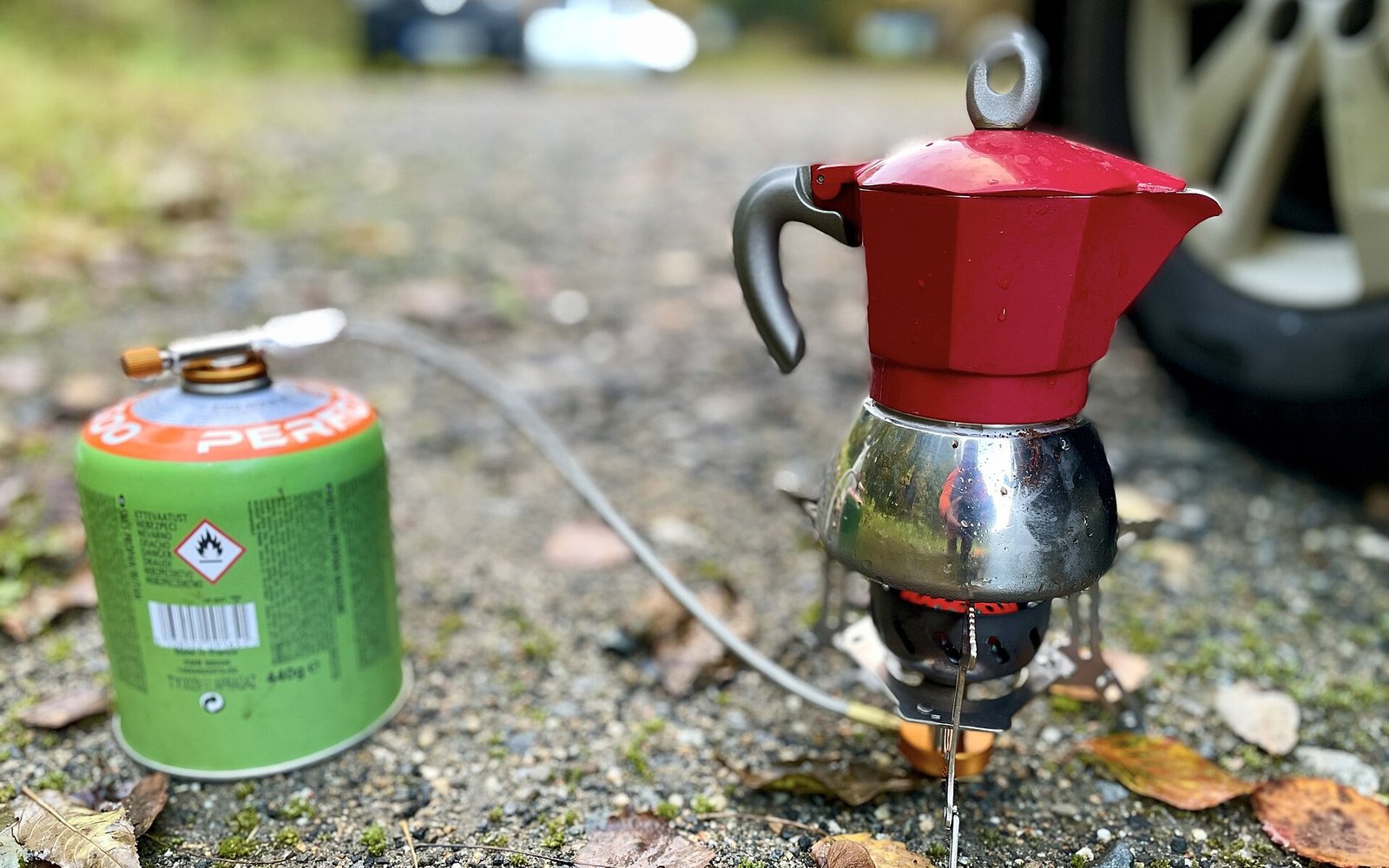
- Cover: Olgierd Rudak, CC BY-SA 4.0, via Wikimedia Commons (cropped).
- How a moka pot works: Coyau, CC BY-SA 3.0, via Wikimedia Commons (cropped).
- How espresso works: massage-techniques, CC BY-SA 2.0, via Wikimedia Commons (cropped).
Scope: Pressure, temperature and extraction figures come from laboratory tests of specific pots and machines. Your own equipment may differ. The brewing steps come from the maker’s instructions, and the advice on the final phase is an inference from the study. Sources checked 7 October 2026.


.jpg)

